

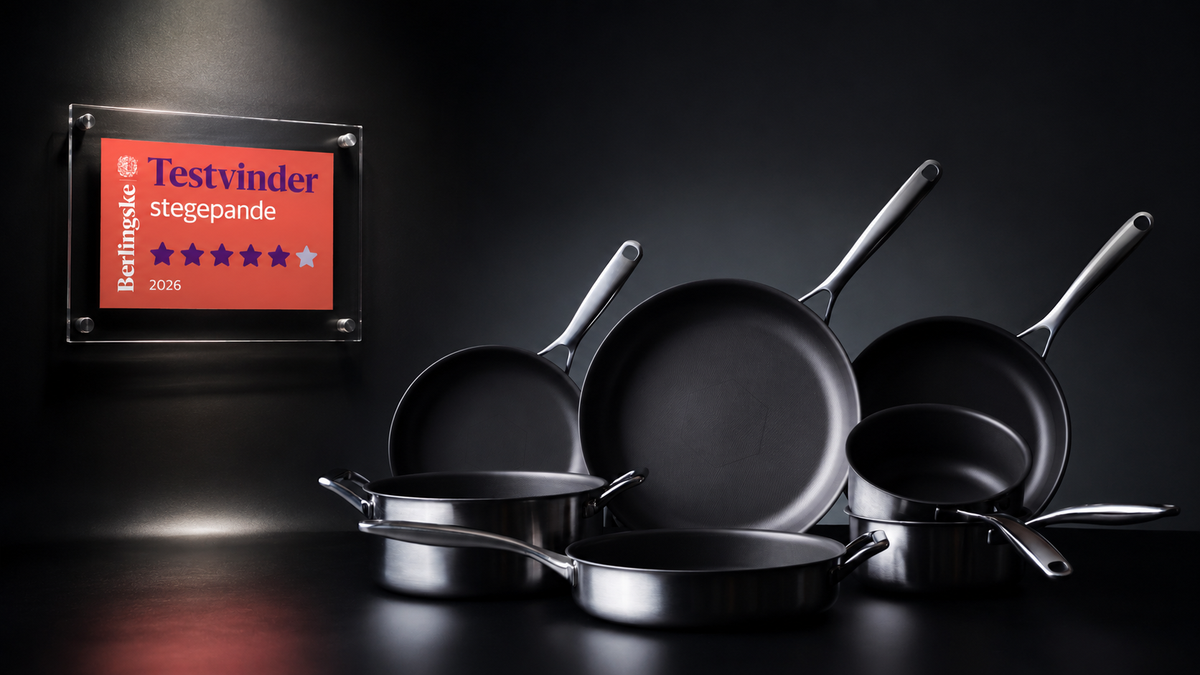
The Onyx Cookware ZERO Natural Non-stick frying pan has received positive recognition in the Berlingske article “Goodbye, Teflon: Food critic has found his new favourites”. The newspaper’s food editor, Søren Jacobsen Damm, tested alternatives to conventional Teflon pans over 12 weeks of use in an ordinary Danish kitchen.
In the article’s conclusion, Berlingske writes that Onyx Cookware ZERO wins by a narrow margin in the comparison because, according to the review, the frying pan will be the easiest for most people to start using. Especially those who have been used to conventional Teflon pans for many years.
The assessment comes at a time when more Danes are looking for cookware without PFAS and PTFE, but still want the ease of use that non-stick frying pans are known for. That very balance is at the heart of the Onyx Cookware ZERO Natural Non-stick frying pan: a frying pan developed to provide a natural non-stick effect without traditional chemical coatings.
A strong alternative to Teflon for everyday cooking
In the Berlingske review, Onyx Cookware ZERO is described as a frying pan that “delivered on almost every measure”. Among other things, it is highlighted for its combination of non-stick properties, even heat distribution and ability to handle both delicate ingredients and conventional frying.
Where traditional Teflon pans typically rely on a PTFE coating, Onyx Cookware ZERO uses a physical surface structure created directly in the steel. The frying pan’s non-stick effect therefore comes not from a conventional chemical or ceramic coating, but from a specially developed surface treatment.
The result is a frying pan for modern cooking, where ease of use, durability and choice of materials matter more than before. It is developed to provide the easy cooking experience many know from non-stick, but in a more robust construction made for daily use.
Natural Non-stick without PFAS and PTFE
The Onyx Cookware ZERO frying pan is developed without PFAS, PTFE and fragile ceramic coatings. Instead, it uses a controlled nitrogen heat treatment that strengthens the steel and creates a fine nanotexture on the cooking surface.
The microscopic structure reduces the contact area between food and frying pan. This provides a natural non-stick effect while the surface remains part of the steel itself. In other words, it is not a layer applied on top of the frying pan, but a physical surface structure integrated into the material.
For the consumer, this means a frying pan that is easy to use every day, yet more robust than many traditional non-stick solutions. It is developed to withstand metal utensils, thorough cleaning and daily use without requiring the same care as conventional coated frying pans.
Developed for both searing and delicate ingredients
One of the clear strengths of Onyx Cookware ZERO is its versatility. Berlingske highlights that the frying pan is suitable for foods such as scrambled eggs and delicate fish, while also handling tasks such as steaks and bacon with even heat distribution and a stable cooking surface.
This makes the ZERO range relevant for home cooks who want one frying pan that can cover most kitchen needs. It needs to work on a busy weekday morning when cooking eggs, but also deliver a good seared crust when there is meat on the cooking surface.
The construction consists of three layers, with stainless steel providing strength and stability, while aluminium contributes to fast and even heat distribution. The frying pan works on all hob types, including induction and gas, and can also be used in the oven. This makes it a versatile frying pan for both quick everyday meals and dishes that need to be finished in the oven.
An easy transition for Teflon users
According to Berlingske’s assessment, Onyx Cookware ZERO stands out particularly because it takes very little getting used to. Many alternatives to Teflon require new techniques, longer preheating or more experience at the hob. The ZERO frying pan, by contrast, is developed to feel intuitive from the first use.
This is an important part of the ambition behind the ZERO range: to make switching away from Teflon simple. Consumers should not have to choose between convenience and better materials. They should be able to get both in the same product.
Recognition for the ZERO range
At Onyx Cookware, Berlingske’s assessment is seen as strong recognition of the development work behind the ZERO range.
“We have worked with a clear focus on creating a frying pan that gives consumers a genuine alternative to conventional Teflon pans. The aim has been to retain the easy cooking experience, but without PFAS, PTFE or fragile ceramic coatings. So naturally, we are proud that Berlingske highlights ZERO for its ease of use and rates the frying pan so positively in the test,” says Rasmus Andersen, CEO of Onyx Cookware ApS.
The ZERO range is developed for the modern consumer who expects more from cookware. It needs to be functional, durable, easy to clean and fit into everyday life, where more people want to make more conscious choices in the kitchen.
A new generation of non-stick frying pans
The Onyx Cookware ZERO Natural Non-stick frying pan is suitable for all hob types, including induction and gas. It is easy to clean, dishwasher-safe and developed for daily use in both small and large kitchens.
The nano-textured surface in hardened stainless steel is made to resist scratches and normal use with metal utensils. At the same time, the ZERO range is created without PFAS, PTFE and fragile coatings, so the non-stick effect comes from the surface structure itself rather than a conventional coating layer.
With the ZERO range, Onyx Cookware has introduced a new generation of natural non-stick frying pans without PFAS, PTFE and ceramic coating. The range is developed for consumers who want the familiar ease of non-stick, but with a more robust and long-lasting surface solution.
The full Berlingske article can be read at Berlingske.


